
Why self-defense?
“Self-defense belongs to anyone who has ever been made to feel small, unsafe, or unseen. It's about tools, practice, and strategy. It's about choice. Self-defense is not reserved for the muscular, the able-bodied, the masculine, the fast, or the trained.” -Rana Abdelhamid
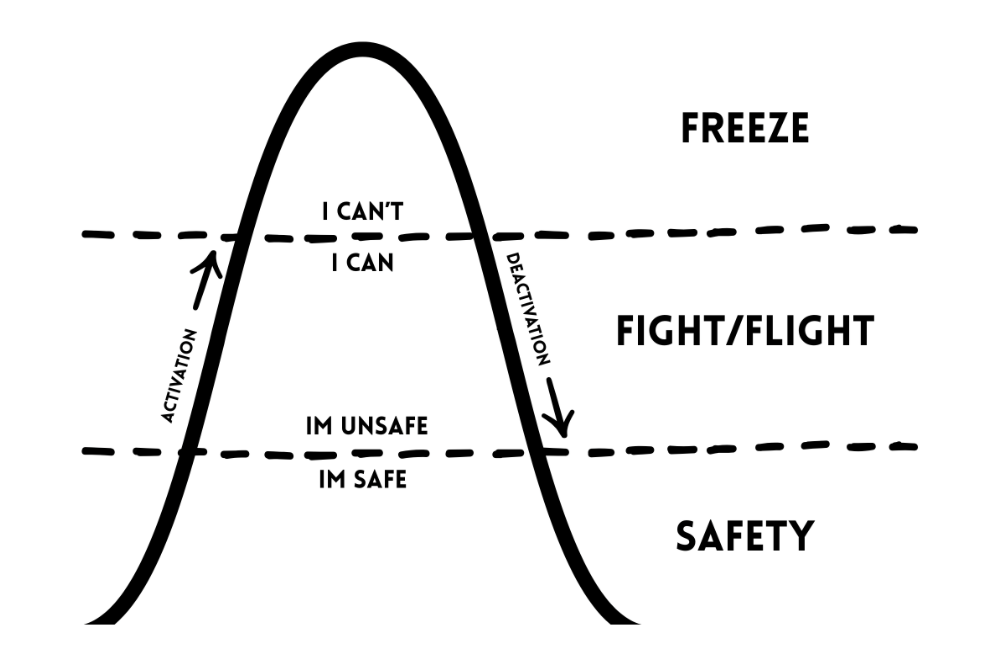
This image shows the path that someone’s nervous system takes as they respond to a threat. In the safety zone someone is not responding to an active threat and their body is in alignment. As a threat appears, the person’s nervous system activates. We briefly move into fight/flight before moving into the freeze zone. We pause as our body attempts to take in all the signals around us. This is where we stay when faced with a threat we don’t know how to respond to. We pause, freeze up, unsure how to proceed. This is where empowerment based self-defense comes in. When faced with a threat, we can build out our choices for how to respond, including verbal de-escalation, bystander intervention, and physical defense tactics. This allows us to move quickly from the freeze peak and into fight/flight within more of our control. Once our body identifies that the threat is no longer present, we can move back into the safety zone with more regulation.
The other thing that self-defense supports, is survivors of gender based violence who find themselves stuck in the freeze/fight/flight zone even after the threat is no longer present. Our bodies remember the trauma and harm we’ve endured. Though self-defense, blocking, kicking, punching, and grappling, we can remind our bodies how powerful we are. That we are in control of the current moment.
The below are pulled segments from Rana’s book, Get Home Safe: A Guide to Self-Defense and Building our Collective Power
Self-defense isn’t just about throwing a strong strike… It's about knowing how to show up in your body with clarity, power, and care. At its core, self-defense is about deescalation: of violence, of fear, of the narratives that tell us we aren't allowed to fight for ourselves.
Some of us, especially marginalized people, are taught to endure harm quietly. To be polite when we're uncomfortable. To smile when we're scared. To stay silent to avoid escalation. Others of us, growing up in neighborhoods policed like war zones or in war zones, are taught to fight. To "never let anyone mess with you." To respond to disrespect with aggression, even when that response might put us in more danger, even when walking away would be safer. But rarely, if ever, are we taught the full range of options available to us. We aren't taught to pause, assess, or set boundaries. We aren't taught to deesca-late with intention or how to fight back with strategy.
Because before it ever gets physical, self-defense is mental. You need to feel safe to develop that self-defense mentality: trusting what you notice, internally and externally.
Before we ever learn how to strike, we learn how to notice. It begins with awareness. It begins with what you feel, in your body, in a room, on a street corner. And it starts in two places: within yourself and in your surroundings.